

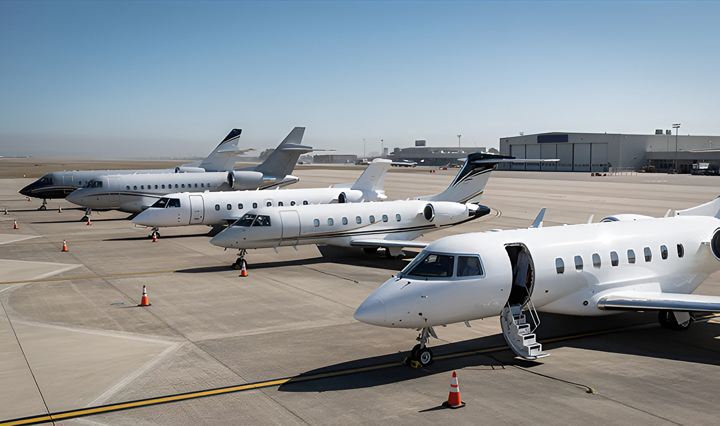
Choosing a private jet charter is not simply about finding the largest or fastest aircraft. The right jet size depends on passenger count, flight distance, cabin comfort, luggage requirements, airport access and budget. Private jets broadly fall into three categories: light, midsize, and heavy jets.
Light jets are ideal for shorter trips and smaller groups. In contrast, midsize jets offer more cabin space and longer range. Finally, heavy jets provide the greatest cabin space, range and amenities.
Light Jets
Light jets typically cater to short- and medium-haul private flights, carrying 5–8 passengers depending on the aircraft and configuration. They offer a practical balance between speed, operating efficiency and airport accessibility for private jet charter travelers.
For instance, with a range of 1,100 nautical miles, the Cessna Citation Mustang is a compact and efficient light jet suited to short regional journeys, offering a practical cabin for smaller groups while retaining the speed and convenience of private aviation.
Light jets are particularly suitable for domestic business trips, regional travel and journeys where keeping travel time and aircraft size manageable is a priority.
Midsize Jets
Midsize jets provide a noticeable step up in cabin space, baggage capacity and range. They lend themselves to longer domestic and transcontinental journeys.
For example, the Citation 560 XLS has a range of 1,850 nautical miles, offering more cabin space and passenger comfort than a light jet. It is well suited to longer domestic and regional journeys where travellers want a balance of range, comfort and efficiency. The broader Citation XLS family is known for a spacious cabin and seating configurations for up to 12 passengers.
Midsize aircraft can therefore be a strong choice when passengers want more room to work, relax or move around without moving into the larger and generally more expensive heavy jet category.
Heavy Jets
Heavy jets sit at the top end of traditional business-jet categories, offering substantially larger cabins, greater baggage capacity and long-range performance. They are designed for extended international journeys and larger groups.
With a range of approximately 6,500 nautical miles, the Gulfstream G550 represents the long-range end of private aviation, offering private jet charter travelers the capability to connect distant international destinations while providing a spacious cabin designed for extended flights.
Large-cabin aircraft such as the Gulfstream G500 and G600 demonstrate the category’s long-haul capability: the G500 has a published range of 5,300 nautical miles, while the G600 reaches 6,600 nautical miles under specified operating conditions.
Which Private Jet Size Should You Choose?
The best private jet size depends on the mission rather than the aircraft’s category alone. For a short domestic flight with a few passengers, a light jet may offer the right balance. In case of longer journeys, a midsize aircraft can provide considerably greater comfort and range. A heavy jet may be the better choice for large groups or nonstop international travel.
At BookMyCharters, the practical starting point is to consider your route, number of passengers, preferred departure airport, baggage and desired onboard experience. These factors can help narrow down the aircraft category that makes the most sense for your journey.
Frequently Asked Questions
What is the smallest private jet category?
Light jets are among the smallest commonly used business jets, offering compact cabins and efficient performance for shorter journeys. BookMyCharters offers a range of light jets on rent, including Cessna Citation 525 A, Phenom 100, and Learjet 45.
Which private jet category has the longest range?
Heavy and large-cabin business jets generally offer the longest ranges. For example, the Gulfstream G550 has a range of approximately 6,500 nautical miles.
Is a midsize jet bigger than a light jet?
Yes. Midsize jets generally offer larger cabins, greater baggage capacity and longer range than light jets. For example, the Cessna Citation Mustang, a light jet, has a cabin approximately 9 ft 9 in long and 4 ft 6 in high, with seating for up to five passengers. By comparison, the Gulfstream G550, a heavy jet, has a cabin about 43 ft 11 in long, 7 ft wide and 6 ft high, with capacity for up to 19 passengers.
Are heavy jets always faster than light jets?
Not necessarily. Jet size does not directly determine speed, as aircraft performance varies considerably by model. For example, BookMyCharters’ light-jet fleet includes the Citation 525 A, which can reach a high-speed cruise of 407 knots, and the Learjet 45, which cruises at around 404 knots. This shows that some smaller jets can deliver speeds comparable to, or potentially higher than, certain larger aircraft.
Which private jet is best for international travel?
For international travel, the appropriate category depends on distance and passenger requirements. Midsize jets can offer intercontinental capability, while heavy jets are generally preferable for longer routes and larger groups.
Does a larger private jet always mean a better flight?
No. A larger aircraft may provide more space and range, but it can also have higher operating requirements and may not be necessary for a short trip with a small group. The ideal aircraft is the one that matches the mission.
What factors should I consider when choosing a private jet?
Consider flight distance, passenger count, baggage, cabin height and configuration, airport runway requirements, nonstop capability and onboard amenities. Range figures should also be treated as theoretical performance numbers because actual range can change with weather, routing, speed, aircraft configuration and passenger load.