

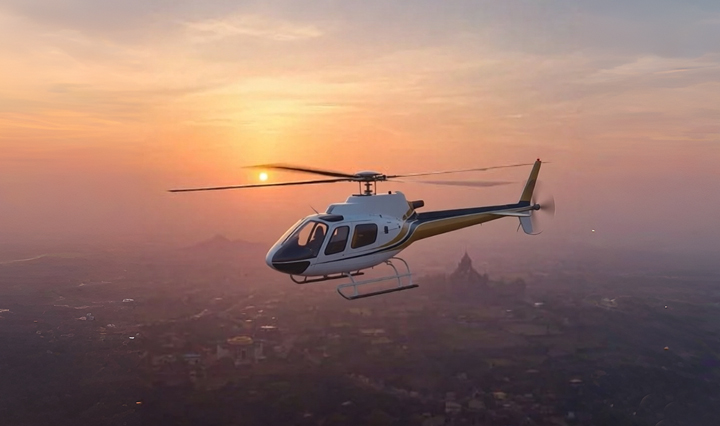
The cost of a helicopter charter depends on several variables, including the aircraft type, flying time, route, fuel prices, landing arrangements, aircraft availability and demand at the time of booking. Helicopter charter rates in India typically range from ₹1.2 lakh to ₹4.75 lakh per flying hour. However, these helicopter charter cost figures are indicative and vary depending on the helicopter specifications and several other factors.
In our previous blog, we covered the factors that determine the cost of a private jet charter. Here, let’s look at what exactly affects helicopter charter prices.
Type and size of the helicopter
Single-engine helicopters generally have lower operating costs than larger twin-engine aircraft. They can therefore be more economical for shorter journeys, sightseeing, point-to-point travel and certain pilgrimage routes.
Twin-engine helicopters, in contrast, generally command higher charter rates because of their larger capacity, configuration and operating economics.
The cost of chartering light single-engine helicopters ranges from ₹1.25 lakh to ₹1.9 lakh per hour, whereas these prices increase to ₹2 lakh to ₹3 lakh for light twin-engine helicopters. Medium twin-engine helicopter charters cost anywhere from ₹2 lakh to ₹3.5 lakh.
Flying time, distance, and airspace restrictions
Helicopter charters cost is often influenced by flying time, so the duration of the journey directly affects the cost.
A longer route naturally means more flight hours and greater fuel consumption. But even a relatively short route can become more expensive if operational conditions increase the flying time.
Helicopters do not always fly the most direct route. Air Traffic Control (ATC) instructions, airport traffic, restricted airspace and temporary operational conditions can require an aircraft to take a longer route, which implies more flight hours, greater fuel consumption, and, consequently, increased helicopter charter cost.
A recent Pune-Mumbai example illustrates this phenomenon clearly. Helicopters operating between Pune and Mumbai typically took around 45 minutes, but route diversions associated with Navi Mumbai International Airport were reported to add 10–15 minutes when ATC required helicopters to alter their route. The additional flying time meant higher fuel consumption and increased operating costs.
Aviation turbine fuel prices
Fuel is a major operating expense in aviation, so changes in Aviation Turbine Fuel (ATF) prices can have a direct impact on charter rates.
IndianOil’s published data shows Mumbai’s ATF price for domestic aviation operations at ₹90,451.87 per kiloliter on March 1, 2026, rising to ₹98,247 per kiloliter on April 1, 2026.
The impact can be substantial when fuel prices rise sharply. In April 2026, a Pune-Mumbai helicopter charter that had earlier cost approximately ₹3.5–₹4 lakh reportedly rose to around ₹5.5 lakh, excluding 18% GST, amid a significant ATF price increase.
Landing, parking, and ground-handling requirements
A helicopter charter can involve more than the aircraft and flight crew. Depending on the airport, heliport or private landing facility, the operation may involve landing, parking, handling and other airport-related charges. Applicable tariffs can vary according to the airport, aircraft characteristics and nature of the operation.
For example, AERA tariff documents calculate certain landing charges with reference to the aircraft’s maximum take-off weight (MTOW) and specify provisions for unscheduled helicopter and general-aviation operations.
Ground handling can also influence the overall helicopter charter rates. An aviation industry representative quoted by The Times of India specifically noted that charter costs depend on the make of the flying machine and ground-handling charges.
Depending on the airport or helipad, helicopter charter cost may include charges for passenger handling, aircraft marshaling, parking, equipment, ramp services and other operational support. These charges are location- and operation-specific, so they are generally quoted separately rather than as a universal hourly rate.
Destination and landing arrangements
Not every destination has the same infrastructure for helicopter operations. A charter may require coordination with an airport, heliport or approved landing facility.
Therefore, if a charter requires a temporary landing site, private helipad or other specially arranged location, the operator may need to obtain permissions and coordinate with the relevant authorities or site owner. Any associated landing-site or usage charges can then become part of the overall helicopter charter cost.
For example, in May 2026, the Himachal Pradesh High Court permitted a helicopter to use the playground of Lal Bahadur Shastri Government Degree College near Rohru as a temporary landing site, subject to a ₹1 lakh usage fee.
Aircraft availability due to high-demand seasons
Charter pricing is also influenced by supply. If several customers are looking for helicopters at the same time but only a limited number of suitable aircraft are available, operators may have fewer aircraft to allocate and may need to position aircraft from elsewhere.
This becomes particularly important during periods of concentrated demand.
For instance, during the January 2026 municipal elections in Maharashtra, operators reported that nearly 12 helicopters had already been booked across Pune and Mumbai, with bookings expected to increase further closer to the polling dates.
Minimum billing hours
The passenger’s actual time in the air is not necessarily the only time that determines the charter bill. Like other jet charter services, the minimum billing hours for helicopter charters is also two hours. Consequently, a shorter helicopter ride may still be quoted at this minimum billing price rather than purely on the basis of its actual flight duration.
Number of passengers and aircraft configuration
The number of passengers traveling can influence which aircraft is suitable. A larger group may require a larger helicopter, while a smaller group may have the option of using a smaller single-engine aircraft. Passenger requirements, baggage and the aircraft’s permissible payload can therefore influence the aircraft selected and, consequently, the price.
The objective should not simply be to find the cheapest helicopter, but to find the aircraft that is appropriate for the passenger count, route and operational requirements.
Aircraft maintenance and operating costs
Operating a helicopter involves substantial recurring costs, including fuel, and scheduled and unscheduled maintenance. Replacement parts, component overhauls and other aircraft-related expenses also add to the aggregate.
Depending on the helicopter’s size and configuration, direct operating costs can run into several lakh rupees per flight hour. The actual helicopter operating cost figure varies considerably by aircraft type, utilisation and local operating conditions. However, industry cost benchmarks place helicopter operating costs broadly in the region of ₹1.3 lakh–₹5 lakh per flight hour.
Taxes and other applicable charges
A standard GST of 18% applies to private jet charters in India. ATF is typically not a separate tax line charged to the helicopter passenger. Nonetheless, ATF prices can materially affect charter rates.
For example, IndianOil’s published Mumbai ATF prices were ₹90,451.87/kL on 1 March 2026 and ₹98,247/kL on 1 April 2026. Consequently, a Pune–Delhi one-way private-charter price reportedly rose from about ₹10 lakh to ₹14 lakh, excluding GST. Similarly, a Pune–Bengaluru charter price rose from around ₹6 lakh to over ₹8 lakh.
Whether you are attending a destination wedding or traveling for business or leisure, the right charter solution should offer more than just an aircraft. It should offer clarity, convenience and a journey planned around your needs.
With BookMyCharters, you can explore charter options based on your specific itinerary and requirements. This makes it easier to compare suitable aircraft and understand the factors that shape the final price.
Frequently Asked Questions: Helicopter Charter Cost
1. What factors determine the cost of a helicopter charter in India?
The cost of a helicopter charter in India is determined by far more than the distance between two cities. Aircraft type, flying time, fuel prices, positioning, landing arrangements, airspace restrictions, aircraft availability, crew requirements and market demand can all influence the final quotation.
2. What is the cost of chartering a private helicopter in India?
Helicopter charter rates in India typically range from ₹1.2 lakh to ₹4.75 lakh per flying hour. However, the rates vary based on several factors, including the type of aircraft, fuel prices, aircraft availability, destination and landing arrangements, etc.
3. Why can two helicopter charter quotes be considerably different?
A helicopter charter quote can change because of:
- the helicopter model;
- single- versus twin-engine configuration;
- passenger and baggage requirements;
- flight duration;
- positioning or ferrying;
- ATF prices;
- landing and handling arrangements;
- ATC or airspace restrictions;
- aircraft availability;
- seasonal or event-driven demand;
- minimum billing provisions; and
- taxes and other applicable charges.
As a result, two helicopter charter quotes can vary considerably.
4. Can helicopter charter prices change based on fuel costs?
Yes. Aviation Turbine Fuel (ATF) is a significant operating expense, so sharp increases in fuel prices can affect charter rates. In April 2026, for example, rising ATF prices were accompanied by significant increases in reported helicopter and private-charter fares in India.
5. Does the number of passengers affect helicopter charter costs?
Yes. Passenger numbers can determine which aircraft is suitable for the journey. A larger group may require an aircraft with greater seating capacity and payload, which can increase the charter cost.
6. Can helicopter charter prices increase during peak-demand periods?
Yes. Aircraft availability and demand can influence charter pricing. During periods such as major elections or large events, limited aircraft availability combined with increased demand can push rates towards the higher end of the market.
7. Can I be served a full-course meal on-board a private helicopter?
Foods that can be served on-board a private helicopter are limited. Helicopters do not have galleys; therefore, there is no provision for storing foods at their ideal temperatures. Moreover, they lack the space to accommodate tables to facilitate comfortable dining. Finally, helicopter rides are usually short, 30–60-minute rides. So, catering on-board helicopters often entails dry snacks, such as high-quality chips, cookies, nuts, and packed beverages.